I. Suttles Pottery
- I. Suttles Pottery
- (1878-1881)
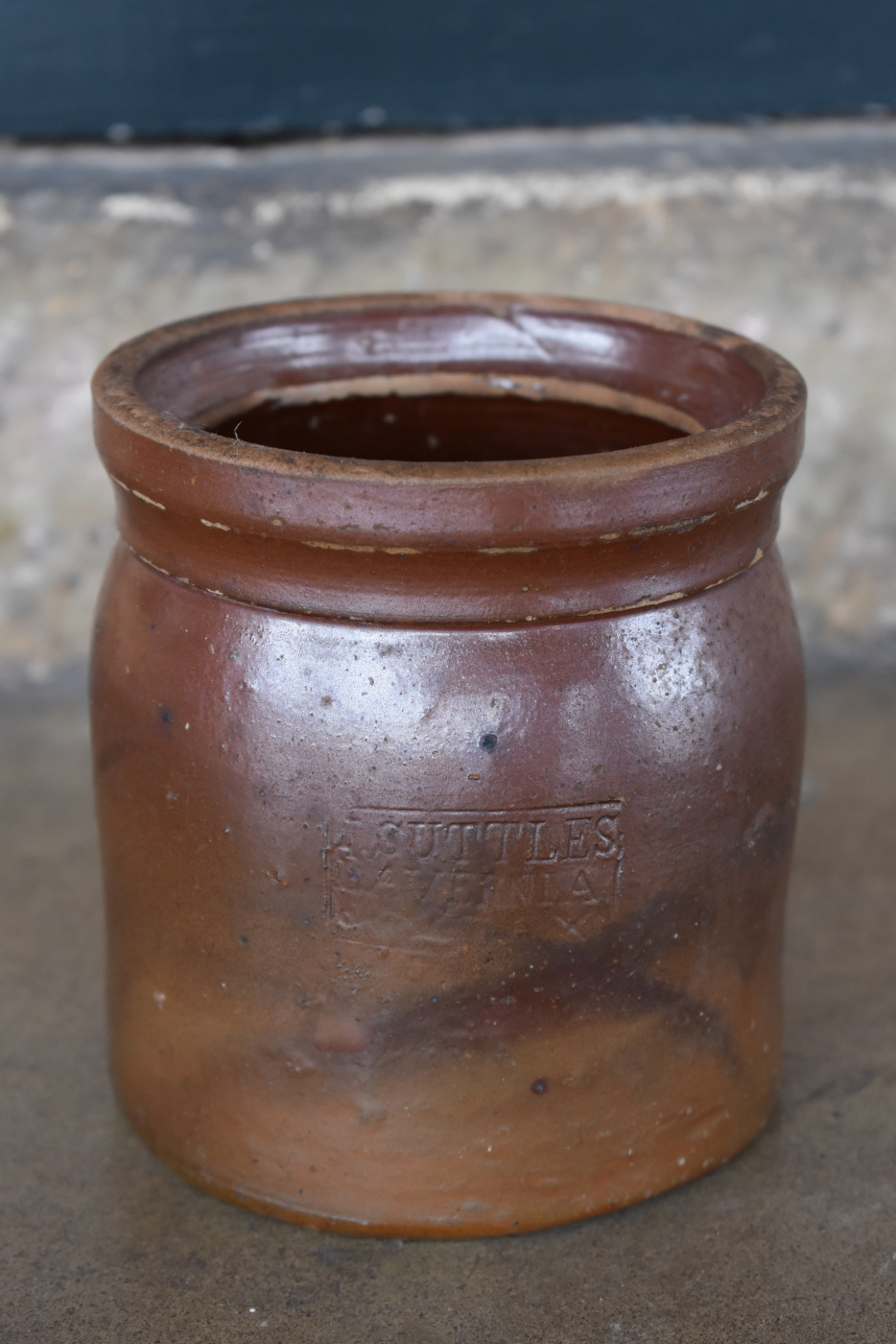
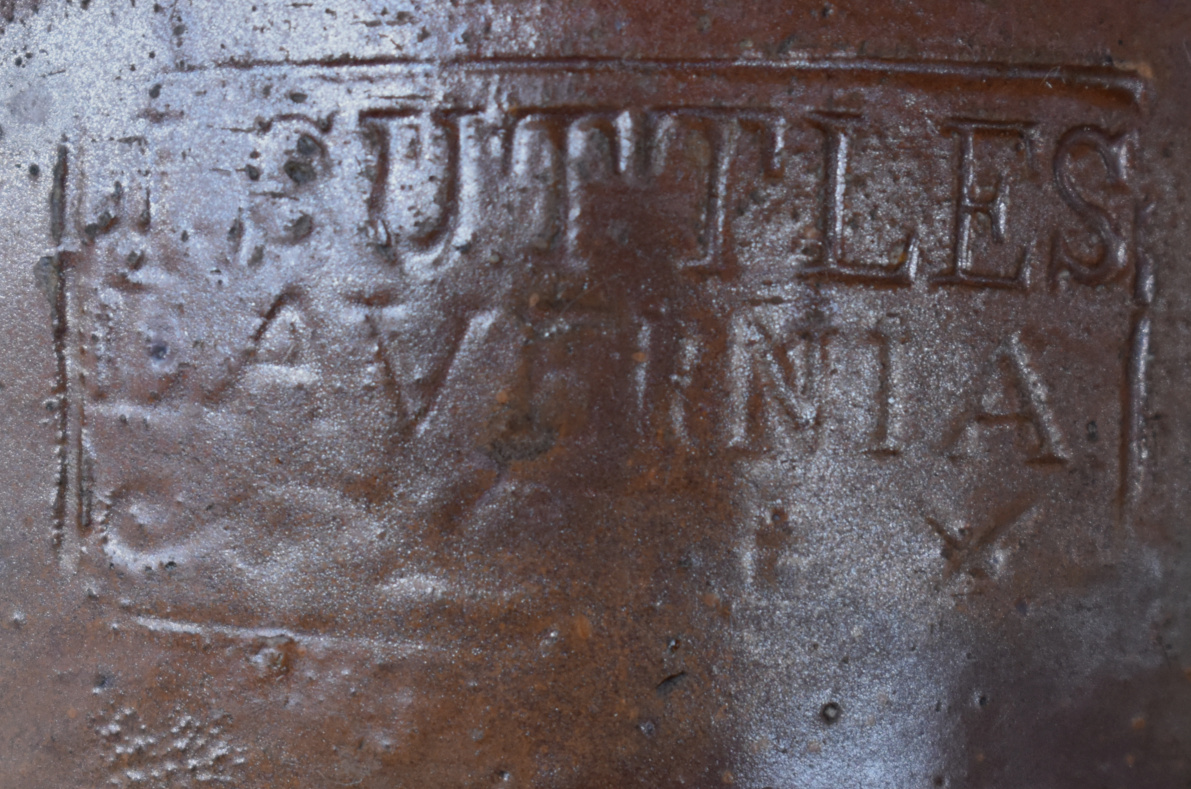
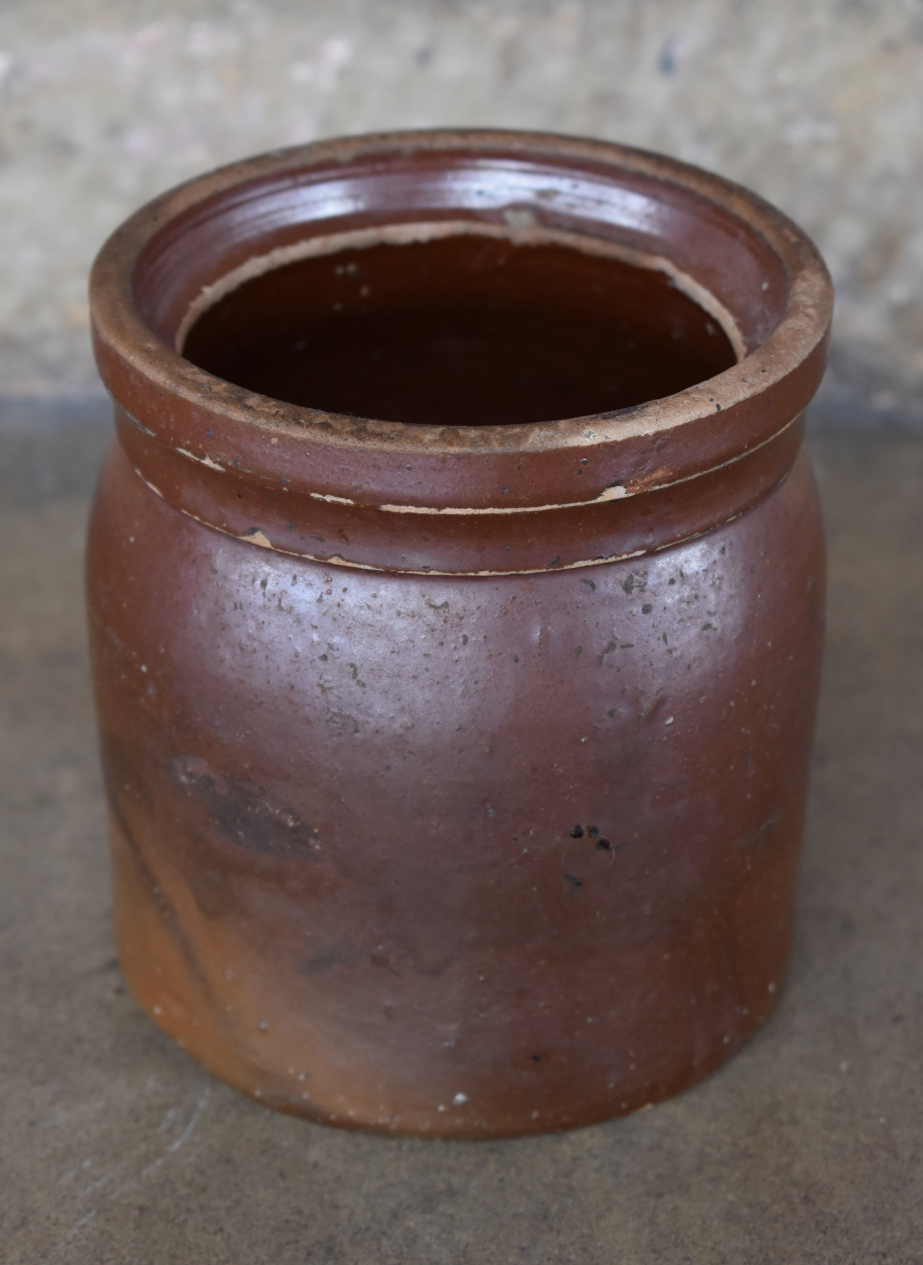
- One quart signed I. Suttles Churn
- 5 1/4 inches tall
- 5 inches across
- Contact for Price & Info
- View All By This Maker
Details
Texas pottery stoneware utilitarian
Biography
I. Suttles Pottery (1878-1881)
"In the 1870s, two Civil War veterans who were potters from near Zanesville, Ohio came to Texas. They were brothers. One brother was Isaac Suttles; the other, George Washington Suttles. They operated a pottery factory in and around the town of La Vernia, Texas. . ."
"George and his brother, Isaac, served in the Union Army during the Civil War. George Washington Suttles joined in the Army in St. Louis, Missouri on April 12, 1865, and served in Company G . . . promoted to Corporal . . ."
"Isaac was in the Union Army also, but for much longer. He enlisted in the U.S. Army Infantry, . . . Ohio Volunteers. . . suffered greatly as a prisoner in the horrible war camp at Andersonville, Georgia."
". . .Suttles was from Ohio, a member of an Irish pottery making family. . .The Wilson Potteries of Seguin was an early business endeavor . . . owned and operated by freed slaves after the Civil War."
". . .He took out an ad in the same paper two months later (August 29, 1878) which read, "Said machine is a dry dirt press, taking the dirt from the bank and forming it into perfect bricks, ready to be set in the kiln. I scraped up the dust on the street and pressed it into a perfect brick. . .The machine is perfect."
". . . George and his wife, Elizabeth, are listed, along with Isaac who is noted as being a member of a Sunday School class, with a perfect attendance record . . . but in 1881. . "
". . .Isaac’s whereabouts are unclear until his death three years later, when he, too, became a ghost."
"Isaac Suttles died in Abilene . . . exact cause and date are unknown. It is said that he died during a robbery, but . . ."
"The inventory of his estate lists 2 white shirts, 4 linen collars, 1 pair drawers, . . . 3 white handkerchiefs, . . . 1 Testament, 1 valise, 1 horse brush, 1 shaving mug, 2 vests, . . .
1 derringer. . ."". . .who refused to turn over the "effects in his hand," unless, the new administrator, "pay a claim of $109.00 for his services."
". . . and as such engaged in selling washing machines and wringers .…"
. . ."Please inform us if there is any record of a coroners inquest over the remains of one Isaac Suttles who was found dead . . . He is supposed to have been murdered, as a bullet hole was found through his head."
". . . Isaac’s widow was too poor to pay the $5 and was therefore unable to . . ."
". . . she stated that she, "has not in any manner engaged in or aided or abetted the rebellion in the United States."
". . . No mention of that talent ever appears again. Further descriptions of his occupation list him as a, "soldier" and once as a, . . . a prisoner of war. . . numerous hospitals during the war . . . in a rebel prison. . . reported as missing in action at Atlanta, Georgia. "
". . . born on Halloween . . . five feet eight inches tall, with gray eyes, brown hair and a fair complexion. . . "
"The kilns operated by the Suttles brothers have been a source of mystery. After an extensive search . . ."
". . . Although Georgeanna passed away. . . she left . . .where she found the most . . .in Texas."
". . . seems to have taken five or six days to fire and cool a kiln. Wood was used and it was stoked for one or two days. Mr. Lenz does not remember the act of salting, but remembers that the inside of the kiln was glistening and had drops of glass coming down from the ceiling. . ."
"Mr. Lenz tells us the story that one day a cow wandered into the pottery shed and knocked over a few things. Mr. Suttles became very angry and picked up pot after pot and threw it at the cow until it left the shed."
. . . "We also recovered a few prehistoric Native American stone tools and debitage, with one diagnostic arrow point, a Scallorn point, dating to the Austin phase of the Late Prehistoric period in Texas, ca. 700 to 1,200 years ago."
". . . .One wonders why the hand which threw so many jars of clay would wither in the end."
The Suttles Pottery has earned a Texas State Historical Marker which will be dedicated early in 2005. Texas Stoneware / Pottery
EXCERPTS FROM THE APPLICATION FOR AN OFFICIAL TEXAS STATE HISTORICAL MARKER FOR THE SUTTLES POTTERY (The complete document, including bibliography, is available upon written request. Contact the La Vernia Historical Association.) By Elaine Mazurek Stephens THE SUTTLES POTTERY OF LA VERNIA, TEXAS By Elaine Mazurek Stephens, Chairman, Suttles Pottery Project A Project of the La Vernia Garden Club And the La Vernia Historical Association Including a report by David Nickels, Project Archaeologist In the 187;-0s, two Civil War veterans who were potters from near Zanesville, Ohio came to Texas. They were brothers. One was Isaac Suttles; the other, George Washington Suttles. They operated a pottery factory in and around the town of La Vernia, Texas from the 1870s to about 1910. Isaac Suttles appeared in Seguin, Texas,.working with the Wilson Potteries in 18701. However, George does not appear in the Wilson County records until 1877. George Washington Suttles was born in White Cottage, Ohio, according to his Civil War Pension records, in either 1843 or 1844. He married Elizabeth Strate at Newton Hill, Ohio or White Cottage, Ohio, in Marc 1861. They 1ve m Roseville, Ohio, until 1876, then moved to Texas because the climate was more favorable for Mrs. Suttles' health. George Suttles died February 3, 1930 in La Vernia, Texas. Both he and his wife are buried in Concrete Cemetery near La Vernia. George and his brother, Isaac, served in the Union Army during the Civil War. George Washington Suttles joined in the Union Army in St. Louis, Missouri on April 12, 1865, and served in Company G of the 14th Regiment of the Missouri Volunteer Cavalry until November 17, 1865. He was promoted to Corporal on May 5, 1865, just prior to the end of the War. Isaac was in the Union Army also, but for much longer. He enlisted in the U.S. Army Cavalry, Company G, 32nd Regiment of the Ohio Volunteers on August 1, 1861 and Was honorably discharged on June 20, 1865. He was 20 years old when he reenlisted in 1863. His service record is extensive. He suffered many wounds and was hospitalized several times. Soon after his discharge, Isaac married Mary Ann McBride on April 22nd of 1866. The marriage was officiated by a Reverend Hagler at Muskingum Co. Ohio. Soon after, Isaac and George moved to Texas. The Floresville Chronicle-Journal reported in an article appearing on September 16, 1960, "During the 1865-1870 period, many more settlers moved in and purchased land. Such substantial families as the Suttles, Suhres, McClains, Warrens, lrvings, News, McGees, and others .. .. At this time, pottery was made by two Suttles brothers, a short distance out in the Sand Hills. The one brother, George Washington Suttles, moved to town and bought the old Erskin Store which stood on Main Street, [now known as Chihuahua Street] south. He also purchased the home place directly behind it. . . After his purchase of the Erskin Store, he installed a huge down draft kiln with a 5000-gallon capacity. The green ware was stacked in the kiln by hand and fired by wood for forty-eight hours after closing. The finished product when removed from the kiln was then hauled to market by wagon; the 1 Handbook ofTexa~ Online:
George Washington Suttles, c. 1910. Photo courtesy of Bernice Suttles Anderwald, Granddaughter, and Charlie Anderwald Hanzelka, Great Granddaughter, of George Suttles. markets being Seguin, Floresville and Stockdale. Here also he had installed a brick making 'machine' and many of the old fireplaces and chimneys were built of these bricks. ... " On June 6, 1878, Isaac obtained an exclusive license to use a brick machine within the County of Wilson, State of Texas. In 1872, Isaac Suttles appeared on the Wilson County Tax Rolls on microfilm roll number one. He was reported to own one horse valued at $30.00. In 1873 through 1876, Isaac continued to be listed on the same tax rolls. In 1876, Isaac was taxed, according to abstract number 123, for six acres valued at $500.00, and for one mule, an animal used often by early potters. Isaac offered the brick making machine for a rental fee. He took out an ad in the Sutherland Springs Frontier Chronicle (August 29, 1878) which read, "Said machine is a dry dirt,press, taking the dirt from the bank and forming it into perfect bricks, ready to be set in the kiln. I scraped up the dust on the street and pressed it into a perfect brick. This machine claims 500 tons pressure. One man can get his dirt, press and set in kiln 2,000 brick per day or three men can run out from seven to ten thousand and set in kiln. The machine is perfect. I will sell yard rights for from one hundred to one hundred and fifty dollars; cash. I am Agent for adjoining counties. For further particulars, write to or call on I. Suttles. at Pottery, near Lavernia, Tex. June 10th, 1878." On March 14, 1881, Isaac sold seven acres in Wilson County "near Lavernia" including 'The Pottery," house, shop mills and "Clay bank" to William Lyon and John Stewart for eight thousand gallons of stoneware, according to a deed filed in the Wilson County Courthouse.2 Lyon and Stewart went on to operate another pottery in Denny, Texas, according to Jon St. Clair, an antiques dealer in Austin. Also in 1881, Isaac and other Suttles were listed as members of the Asbury Methodist church, which is now the La Vernia United Methodist Church. The founder' s names for this church include Mr. and Mrs. G. W. Suttles. George and his wife, Elizabeth, are listed; along with Isaac who is noted as being a member of a Sunday School class, with a perfect attendance record. Isaac Suttles died mysteriously in Abilene, Texas in September of 1884. The exact cause and date are unknown. It is said that he died during a robbery, but no records have been found to substantiate that story. His probate records reveal he died, "at Abilene in Taylor County, Texas without leaving any will known to this applicant, that said Isaac Suttles had his domicile in Wilson County, Texas at the time of his death .. . "3 2 Wilson County Direct Deed Records, March 14, 1881, Book I, Pg. 37. 3 Wilson County Probate Records, Vol. C. pg. 200. 29
From the Civil War pension application filed by Isaac's widow, Mary Ann McBride Suttles, the sad ending of lsaac's life is told. J. W. & 0 . L. Martin, who were, "Attorneys and Solicitors of Pensions, Back Pay, Bounty, Etc" (as quoted from their letterhead), sent this letter, at Mary Ann's request, on February 5, 1891, to the Coroner in Abilene, Texas, "Please inform us if there is any record of a coroners inquest over the remains of one Isaac Suttles who was found dead in the vicinity of Abilene in the latter part of Sept. 1884. He is supposed to have been murdered, as a bullet hole was found through his head." No further records of lsaac's death, nor his grave, have ever been located. The kilns operated by the Suttles brothers have been another source of mystery. After an extensive search by archaeologist David Nickels, the site of George Washington Suttles' kiln was finally determined to be located in the heart of La Vernia. It is on the private property owned by Otto Santos, behind what is now the Los Santos restaurant. Absolutely nothing remains o that pottery site. Pottery lid with the number '2 'found at the G. Suttles site. This was the largest piece of pottery found at the archaeological dig, directed by David Nickels. Excerpts from David Nickels' Archaeological report: (Nickels is the owner of the archaeological consulting firm, Tierras Antiguas): In the 1970s and 1980s, a lady by the name of Georgeanna Greer, with a passion for stone wares traveled throughout Texas, driven to find, photograph, map, and record late 1 gth and early 19th century pottery kilns. Although Georgeanna passed away in the 1980s, she left two filing cabinets full of her documents and notes • THE FOLLOWING IS VERBATIM FROM GEORGEANNA GREER'S FILES: Mr. Eddie Lenz of La Vernia has related incidents relevant to the pottery to me. He lived nearby and crossed the yard of the pottery as he went to school each day. He also helped load and unload the kiln for the wage of 15 cents for half a day. He remembers that Mr. Suttles and his granddaughter Bertie (Alma) Irvine, a very large and strong young woman, did much of the turning on the wheel in the early 1900s. There was also a young Irish man named Tom Connelly [he later became a Texas Ranger] who did some of the wheel work, prepared clay, mixed slip, and helped load and unload the kiln. The clay was brought from a pit in the "sand hills" ... by oxcart because of the difficulty of hauling through the sand. It was broken up and mixed with water and run through a sort of mixer where it was combined with sand. This was a wooden frame about 4 ft. square and 6 ft. high which had a series of wire grids within it. It emerged from the bottom in a roll and was then sliced, rocks removed, and weighed and made into balls for use on the wheel. It was stored wrapped in damp bags. 30
Mr. Suttles did try a mill with a horse to turn it, but did not like it. A treadle type kick wheel with a heavy steel counter wheel was used. The finished ware was then dipped in slip or lined with slip and stored in long sheds to dry. We suppose that he used Albany slip clay, but some red clays lie close by (Red Bluffs). The kiln was a large rounded updraft type with a high "flue." It was loaded with dry ware and fired with wood. It seems to have taken five or six days to fire and cool a kiln. Wood was used and it was stoked for one or two days. Mr. Lenz does not remember the act of salting, but remembers that the inside of the kiln was glistening and had drops of glass corning down from the ceiling. As the kiln was unloaded Mr. Suttles took each piece and placed it in water to test it for cracks - all imperfect pieces were discarded. The only stamp used was for the number. [inserted note from Stephens: George Suttles seldom marked his pottery, except with a number indicating the capacity, in gallons. Isaac Suttles, on the other hand, usually marked his pottery with the imprint, "I. Suttles. Lavernia, Tex."]. Some four or five years before the pottery stopped working the top of the kiln fell in, but Mr. Suttles reworked it and used it for several more years. Mr. Lenz tells us the story that one day a cow wandered into the pottery shed and knocked over a few things. Mr. Suttles became very angry and picked up pot after pot and threw it at the cow until it left the shed. END OF VERBA TIM FROM GEORGEANNA GREER'S MANUSCRIPT (End of excerpts from Nickels report.) The Suttles brothers left much more than jars of clay in La Vernia. They left their inspiring stories, a few mysteries and a glazed and glistening place in the sandhills of Texas. The vessel on the left was made by George W. Suttles. The crock on the right was made by Isaac Suttles prior to his mysterious death in 1884. ! 31