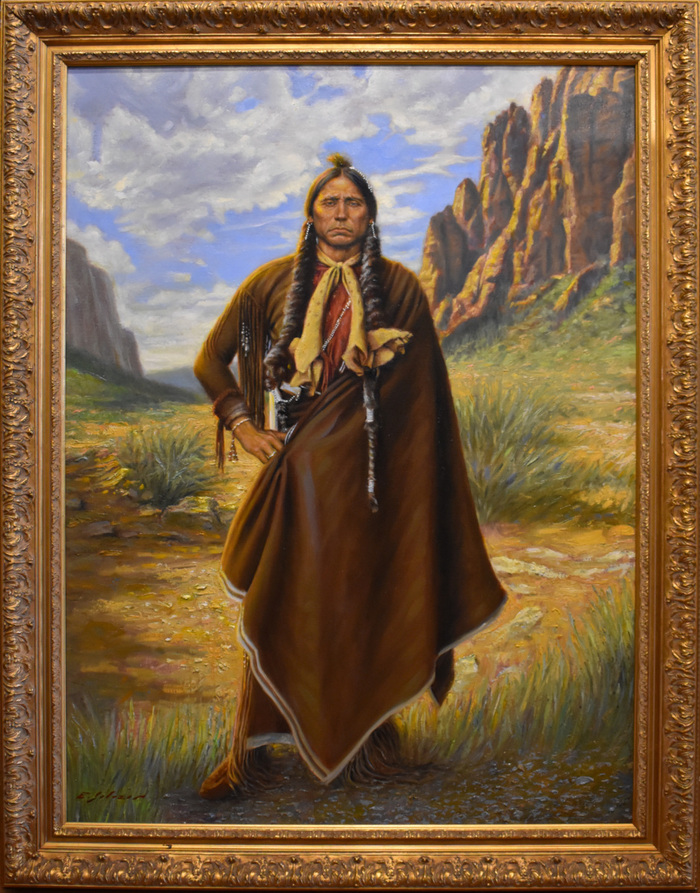
E. Salazar "The Strength of the Bear" Bear's Belly
- E. Salazar
- Texas Artist
- Image Size: 40 x 30
- Frame Size: 48 x 38
- Medium: Oil on Canvas
- "The Strength of the Bear" Bear's Belly
- Contact for Price & Info
- View All By This Artist
Details
From The North American Indian: Born in 1847 at Fort Clark, in the present North Dakota. He had had no experience in war when at the age of nineteen he joined Custer’s scouts at Fort Abraham Lincoln, having been told by old men of the tribe that such a course was the surest way to gain honors. Shortly after his arrival Custer led a force into the Black Hills country, and on the other side of the divide there was a slight encounter with five tipis of the Sioux, in the course of which the young Arikara counted two first coups and one second. Bear’s Belly fasted once. Going to an old man for advice, he was taken to the outskirts of the village to an old buffalo-skull, commanded to strip, smear his body with white clay, and sit in front of the skull. When he had taken the assigned position, the old man held up a large knife and an awl while he addressed the buffalo-skull: ” This young man sits in front of you and is going to endure great suffering. Look upon him with favor, you and Neśhánu, and give him a long and prosperous life.” With that he cut pieces of skin from the faster’s breast and held them out to the buffalo-skull. Bear’s Belly married at the age of nineteen, soon after counting his coups. He became a member of the Bears in the medicine fraternity and relates the following story of an occurrence connected with that event:” Needing a bearskin in my medicine-making, I went at the season when the leaves were turning brown, into the White Clay hills. All the thought of my heart that day was to see a bear and kill him. I passed an eagle-trap but did not stop it was a bear I wanted, not an eagle. Coming suddenly to the brink of a cliff I saw below me three bears. My heart wished to go two ways: I wanted a bear, but to fight three was hard. I decided to try it, and, descending, crept up to within forty yards of them, where I stopped to look around for a way of escape if they charged me. The only way out was by the cliff, and as I could not climb well in moccasins, I removed them. One bear was standing with his side toward me; another was walking slowly toward him on the other side. I waited until the second one was close to the first and pulled the trigger. The farther one fell; the bullet had passed through the body of one and into the brain of the other. The wounded one charged, and I ran, loading my rifle, then turned and shot again, breaking his backbone. He lay there on the ground only ten paces from me, and I could see his face twitching. A noise caused me to remember the third bear, which I saw rushing upon me only six or seven paces away. I was yelling to keep up my courage, and the bear was growling in his anger. He rose on his hindlegs, and I shot, with my gun nearly touching his chest. He gave a howl and ran off. The bear with the broken back was dragging himself about with his forelegs, and I went to him and said, ‘I came looking for you to be my friend, to be with me always.’ Then I reloaded my gun and shot him through the head. His skin I kept, but the other two I sold.”
Bear’s Belly – Arikara Warrior and Cultural Symbol
Bear’s Belly, also known as Kúnúh-kanánu, was a member of the Arikara people born in 1847 at Fort Clark, present-day North Dakota Curtis Legacy Foundation. He joined Custer’s scouts at Fort Abraham Lincoln at age 19, reportedly following tribal advice that military service was the surest path to honor Curtis Legacy Foundation. His early military service included a skirmish in the Black Hills where he earned his first and second coups Curtis Legacy Foundation.
Spiritual Journey and Bear-Skin Ceremony
According to his own account, Bear’s Belly fasted once and underwent a sacred rite. An elder took him to an old buffalo skull, instructed him to strip, smear his body with white clay, and sit before it. The elder then cut pieces of the buffalo’s breast skin and offered them to the skull, blessing him for a long and prosperous life Curtis Legacy Foundation. This ritual marked his entry into the Bears in the medicine fraternity, a spiritual and warrior group among the Arikara collections.starkculturalvenues.org.
The Bear Hunt
To obtain a bear-skin for medicine-making, Bear’s Belly ventured into the White Clay hills when the leaves were turning brown. There, he encountered three bears. After a series of shots and maneuvers, he killed all three, including a third bear that charged him just six or seven paces away Curtis Legacy Foundation. The bear-skin he acquired became a sacred emblem of his spiritual power and unity with the animal collections.starkculturalvenues.org.
Cultural Significance
In the photograph by Edward S. Curtis (1908), Bear’s Belly is depicted wrapped in his sacred bear-skin, symbolizing the bond between the warrior and the spiritual force he had earned collections.starkculturalvenues.org. The image and his story reflect Arikara traditions of using animal skins in ceremonial and spiritual contexts, as well as the warrior’s role in both physical and spiritual life.
Bear’s Belly’s life and story are preserved in historical records and museum collections, serving as a reminder of Arikara resilience, spiritual practice, and the deep connection between the people and the natural world.
Biography
E. Salazar
Salazar is a classically trained painter whose work draws deeply from historical, cultural, and spiritual themes. He began his formal art education at age 18 at St. Petersburg College in Florida, later moving to New York in 1984, where he spent two decades as a successful illustrator. Specializing in Biblical and historical subjects, he created more than 300 paintings featured in internationally circulated books, journals, and calendars.
Alongside his commercial career, Salazar nurtured a lifelong passion for classical portraiture. He studied under renowned artists such as Nelson Shanks at the New York Academy of Art and participated in workshops with Everett Raymond Kinstler and Max Ginsburg at the Art Students League of New York. He also learned from masters like John Howard Sanden, Richard Schmid, and Daniel Greene, while drawing deep inspiration from historic figures including John Singer Sargent, Jules Bastien-Lepage, and Diego Velázquez.
Salazar’s portraits include public figures such as Vanessa Williams, Rick Fox, Mark Martin, Gato Barbieri, and Lionel Hampton. His work has been exhibited at the prestigious Salmagundi Club in New York and is held in private and institutional collections across the Americas, Europe, and Asia.
As an educator, Salazar has shared his expertise through art history lectures at the Metropolitan Museum of Art. He has been recognized in Marquis Who’s Who for both artistic achievement and educational impact.
Now based in Texas, Salazar is currently focused on painting Western and Native American subjects. He is represented by The Charles Morin Fine Art Gallery in Fredericksburg, Texas, and his work is part of the permanent collection at the Museum of Western Art in Kerrville, Texas. At the heart of his practice is a message of respect—for personal identity, cultural beauty, and shared humanity. Through his paintings, he seeks to inspire reflection on our collective dignity and the enduring importance of peace among all people.
.jpg "E. Salazar \"The Strength of the Bear\" Bear's Belly")