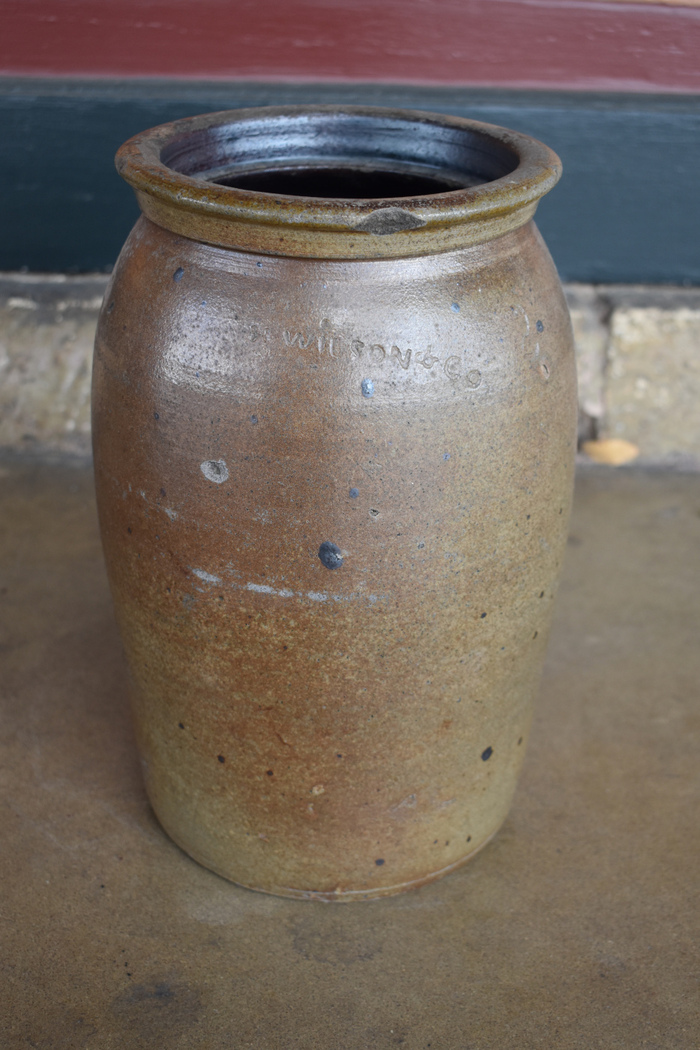
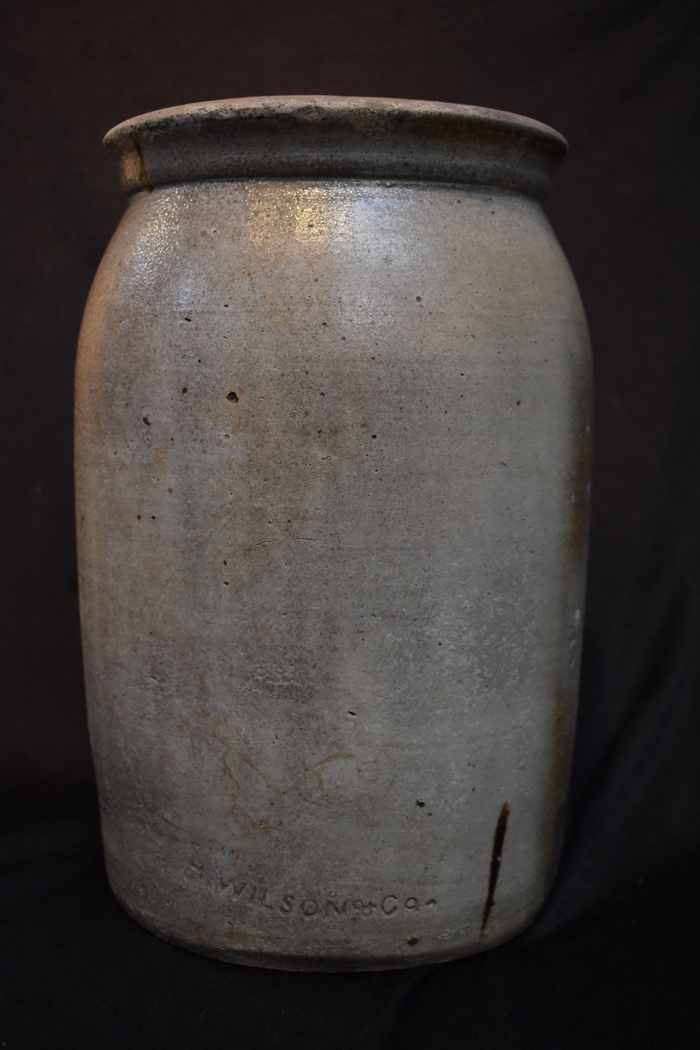
H. Wilson & Co.
- H. Wilson & Co.
- (1869-1887)
- 2 gallon Jar
- 14 inches tall
- Contact for Price & Info
- View All By This Maker
Details
Utilitarian Stoneware
Biography
H. Wilson & Co. (1869-1887)
H. Wilson & Co. (1869-1887)
WILSON POTTERIES. The vessels made at the Wilson potteries of Guadalupe County
represent both the westward extension of Old South cotton culture and the
interaction of different cultural groups in mid-nineteenth-century Texas. During the
last half of the nineteenth century the three potteries in the community of Capote,
near Seguin, supplied a wide area of Central Texas with locally made stoneware
necessary for both food storage and preparation. In 1857 John McKamey Wilson, a
Presbyterian minister and educator, established the first Wilson pottery, which
produced utilitarian alkaline-glazed and salt-glazed stoneware through the Civil War
years. Rev. Wilson was not a potter, so the initial pottery operations were probably
conducted by his slave potters, Hiram, James, George, and Andrew Wilson. Between
1860 and 1866 a white potter, Marion J. Durham, from Edgefield, South Carolina, and
a black potter named John Chandler came to work at the site. Chandler might have
been a free man of color or may have belonged to Durham. Durham and Chandler
may have influenced the other potters, because most of the pottery found at the
earliest Wilson pottery resembles that of the celebrated Edgefield District of South
Carolina. The Edgefield District was a center of pottery-making in the South in the
early nineteenth century. Many scholars attribute the creation of the southern
alkaline-glazed pottery tradition to this period and place. This complex of
technologies included the use of an alkaline-based slip glaze, long-tunnel kilns
known as "groundhog kilns," and ovoid utilitarian forms sometimes decorated with
slip trailing. This southern pottery tradition spread westward with migrating potters,
both free and slave, who were largely trained in Edgefield. The pottery contrasted
sharply with the salt-glazed stoneware tradition that dominated the border South
states northward into the Ohio valley.The site of the first Wilson pottery near Seguin has most of the characteristics of
this southern pottery complex, including green, alkaline-glazed potsherds in a large
waste pile and the long, narrow surface indications of a groundhog kiln. However,
salt-glazed potsherds also littered the site. The presence of the salt glaze, which
was the preferred stoneware glaze from the Mid-Atlantic southern states and states
farther north, suggests the presence of a potter from that area. This potter could
have been one of the slaves or perhaps Isaac Suttles, an Ohioan who worked with
M. J. Durham and Thomas Chandler in 1870, and who could have been present at the
first pottery. The wide variety of vessel forms made at this first Wilson site attests to
the isolated frontier conditions in Central Texas. Forms such as chamber pots,
churns, bowls, pitchers and storage jars were made to satisfy local needs. The Civil
War disrupted the lives of all the potters in Capote. After the troops went home and
the slaves were freed, the potters at the Wilson potteries relocated to two separate
shops in 1869. One was run by M. J. Durham, with John Chandler and Isaac Suttles,
and the other was run by the former slaves, Hiram, James, and Andrew Wilson. H.
Wilson and Company was one of the rare examples of a pottery owned and operated
by a black man in the nineteenth-century South. Its product combined attributes that
can be traced to the earlier Wilson pottery, such as vessel shape and the use of a
groundhog kiln, along with some idiosyncratic additions, such as a new type of rim
and handle. Hiram and Company only made salt-glazed ware and always marked the
vessels with the company's name, a practice not followed by most contemporaries.Hiram Wilson assumed a role in Capote similar to that of his former master in Seguin.
He started a church and a school, as well as a pottery. The separation of the black
Wilsons into a freedman's community may have been a response to postwar
violence and general hard feelings evident in reports of Freedman's Bureau
officers in Seguin. Two instances of violence against the Wilsons were reported in
1867. H. Wilson and Company went out of business about the time of Hiram's death in
1884. Some of the men, including James Wilson, then went to work with Durham and
Chandler at their pottery, which continued operation until about 1903.
BIBLIOGRAPHY:Joe Brackner, Jr., "The Transition from Slave Potter to Free Potter: The Wilson
Potteries of Guadalupe County, Texas," in Texana II: Cultural Heritage of the
Plantation South (Austin: Texas Historical Commission, 1982). Elmer Joe Brackner, Jr.,
The Wilson Potteries (M.A. thesis, University of Texas at Austin, 1981).
John M. Wilson, Jr. became a key figure in the pottery trade in Texas after founding Guadalupe Pottery in 1857 in Guadalupe County, 12 miles east of Seguin. Wilson’s enslaved workers Hyrum, James, Wallace, George, and Andrew were instructed locally in the craft, where they honed their skills through practice and exposure to other potters.Following the end of the Civil War in 1865, Wilson’s newly emancipated laborers took his surname, a common practice at the time, and then formed their own company in 1869. H. Wilson & Company went into production between 1869 and 1872 on land granted to them by John Wilson, and is considered to be the first African American business in Texas. Years of experience working under Wilson provided the knowledge and skills needed to establish and operate a pottery. The enterprise’s success provided a livelihood for the potters that was different from the sharecropping and tenant farming that essentially tied African Americans to the land in a manner much like slavery.
The freedmen created a new style of pottery, breaking from the older traditions of their teachers. These new techniques included adding horseshoe shaped handles and signing their work. Prior to the Civil War, a potter working in the South rarely marked his wares, but by the 1870s the practice became more commonplace. The potters of H. Wilson & Company marked their wares with the company name, a promotional tool for identifying and advertising. More than that, the marks served as a symbol of their remarkable achievement within just a few years of emancipation. For Hyrum Wilson, the company provided a means to support his family and community, as well as serve as a spiritual leader. H. Wilson & Company became a symbol of what was now attainable in a new society.
Today, the archaeological evidence at the site of H. Wilson & Company provides an immeasurable amount of information about the company, as well as the community. These vessels can still be found today throughout central Texas in old barns and homes, as well as in antique shops, private collections, and museums. The Wilson Pottery Foundation, formed by descendants of the Wilson family, has opened the Wilson Pottery Museum in Seguin where the legacy of Wilson pottery is being preserved for generations to come.
“Yours, for God and humanity.” This was the profound and customary closing to letters written by Pastor Hiram Wilson. Why is he remembered today in Texas History?
Born in 1836, Hiram was one of 19 slaves that Presbyterian minister John McKamey Wilson brought from North Carolina to Capote, Texas (near Seguin). In 1857, Rev. John Wilson opened a pottery shop with slaves Hiram and James as the principal craftsmen. Upon Emancipation, Hiram and his brothers James and Wallace, founded their own pottery business, H. Wilson & Co.
Today, H. Wilson & Co. is widely considered to be Texas’ first Black-owned business. They produced practical stoneware like jugs, crocks, and jars. Amazingly, these upstart entrepreneurs initiated innovative techniques including horseshoe shaped handgrips which lessened the possibility of broken handles. They also marked their wares with the company name to promote and identify their unique products.
Over 150 years later, H. Wilson & Co. pottery items are treasures that are found predominantly in private collections, prestigious antique shops, and select museums. All H. Wilson & Co. pottery is rare, of superior quality, and highly collectable. This pottery has been featured at The Bob Bullock Museum in Austin, the Witte Museum in San Antonio, and the Museum of Fine Arts in Houston.
But for Hiram Wilson, the pottery business had a higher purpose than financial gain. Wilson used his profits to help emancipated slaves get established in life. Hiram purchased large tracts of land for the settlement of the town of Capote, setting aside 10 acres for a church, school, and cemetery. Much of the remaining land was given to former slaves to launch farms and businesses.
As a dedicated minister, Wilson founded the Capote Baptist Church and served as the first pastor. Hiram’s brother James bought the first organ for the church. Hiram was often invited to preach at other churches including Seguin’s Second Baptist Church, and churches in Toronto, Canada, and Boston, Massachusetts.
Hiram was fond of writing letters to other ministers to update them on his activities. In one letter that was written while he was still a slave in 1852, Wilson wrote: “On Saturday last I called at a house where I expected to find distress and supplied a poor woman with provisions who told me she had nothing in the house to eat but a morsel of cornbread and her husband was out in the woods with crippled hands which had been frozen, trying to chop and earn something to live on. On relieving this family which I had to go in debt to do - I had hardly time to turn round till I was applied to for the relief of another poor man of a large family.”
Hiram Wilson signed the letter, “Yours, for God and humanity.”
Wilson represents the core moralities of Christianity. Jesus said in John 15:13 NIV: “Greater love has no one than this: to lay down one's life for one's friends.” May we also say, “Yours, for God and humanity.”